
Radiation
Radiation as one model component
Shortwave and longwave radiation are bundled into a single model component model.radiation. The default is Radiation, which holds a shortwave and a longwave scheme and calls them in that order for every grid column
using SpeedyWeather
spectral_grid = SpectralGrid()
radiation = Radiation(spectral_grid; shortwave = OneBandShortwave(spectral_grid), longwave = OneBandLongwave(spectral_grid))
model = PrimitiveWetModel(spectral_grid; radiation)
model.radiationRadiation{OneBandShortwave{DiagnosticCl...} <: SpeedyWeather.AbstractRadiation
├ shortwave::OneBandShortwave{DiagnosticClouds{Float32}, BackgroundShortwaveT...
└ longwave::OneBandLongwave{FriersonLongwaveTransmissivity{Float32}, OneBandL...Either stream can be nothing to switch it off, e.g. Radiation(spectral_grid; shortwave = nothing). The individual schemes are accessed as model.radiation.shortwave and model.radiation.longwave. A radiation scheme that computes both streams at once (for example a correlated-k scheme that shares its gas optics between shortwave and longwave) subtypes SpeedyWeather.AbstractRadiation directly, implements parameterization!(ij, vars, scheme, model) for both streams, declares its variables via variables(::MyRadiation) (the standard radiation diagnostics such as outgoing_longwave and surface_shortwave_down are those of variables(::AbstractShortwave) and variables(::AbstractLongwave)), and is passed as radiation = MyRadiation(spectral_grid).
Radiation schemes from NumericalRadiation.jl
SpeedyWeather itself includes simple radiation schemes, described in the rest of this page: a uniform cooling, the Jeevanjee temperature-flux longwave, and one-band longwave and shortwave schemes with diagnostic clouds. More comprehensive schemes are provided by NumericalRadiation.jl through a package extension that is active as soon as both packages are loaded:
ClearSkyEcCKDRadiation: clear-sky correlated-k gas optics (ecCKD, the gas-optics models of ECMWF's ecRad) with 32 or 64 longwave and 32, 64 or 96 shortwave g points, interpolated from tabulated coefficients for every column. Longwave and shortwave are solved from one gas-optics evaluation, with Rayleigh scattering in the shortwave. CO₂ follows the model's greenhouse gases; ozone comes from an analytic default profile until SpeedyWeather has an ozone field, other gases are prescribed with the scheme (mole_fractions).AnalyticBandLongwave: NumericalRadiation's analytic 41-band clear-sky longwave scheme of Williams (2026) for water vapour and CO₂, usable as it is as the longwave part of aRadiation; see its documentation for the scheme's parameters.
Both are NumericalRadiation's own scheme types, used like any other SpeedyWeather scheme; the extension adds constructors from a SpectralGrid. Add NumericalRadiation (version 0.1.1 or later) with Pkg.add("NumericalRadiation"):
using SpeedyWeather, NumericalRadiation

spectral_grid = SpectralGrid(truncation = 31, nlayers = 8)

# ecCKD for both streams: the reference 32x32 model, or e.g. ClearSkyEcCKDRadiation(spectral_grid, "64x96")
radiation = ClearSkyEcCKDRadiation(spectral_grid)
model = PrimitiveWetModel(spectral_grid; radiation)
simulation = initialize!(model)
run!(simulation, period = Day(10))
simulation.variables.parameterizations.outgoing_longwave

# or the analytic-band longwave next to the default one-band shortwave; keywords are the scheme's
# parameters, e.g. the surface emissivities (SpeedyWeather has no field for them)
longwave = AnalyticBandLongwave(spectral_grid; ocean_emissivity = 0.98, land_emissivity = 0.97)
model = PrimitiveWetModel(spectral_grid; radiation = Radiation(spectral_grid; longwave))
Both schemes take CO₂ from the model's co2 component when present (see Greenhouse gases) and use 280 ppm otherwise.
The first ClearSkyEcCKDRadiation downloads the ecCKD coefficient tables (a lazy artifact of NumericalRadiation). Its work arrays, optical depths per g point, interface fluxes and the surface emission, are parameterization variables in the ecckd namespace, simulation.variables.parameterizations.ecckd. The scheme is clear-sky, about 3x the cost of the one-band pair at T31 with 8 layers, and further gases of an ecCKD model are passed as mole_fractions = (; ch4 = 1.8e-6); see NumericalRadiation's documentation for the scheme.
Work in progress
NumericalRadiation is still in an early stage and not yet fully validated.
Longwave radiation implementations
Currently implemented is
using SpeedyWeather
subtypes(SpeedyWeather.AbstractLongwave)
5-element Vector{Any}:
JeevanjeeRadiation
OneBandLongwave
SpeedyWeather.AbstractLongwaveRadiativeTransfer
SpeedyWeather.AbstractLongwaveTransmissivity
UniformCoolingSee Parameterizations for the general parameterization interface these implement.
Uniform cooling
Following Pauluis and Garner (2006), the uniform cooling of the atmosphere is defined as
with
Jeevanjee radiation
Jeevanjee and Zhou (2022) (Eq. 2) define a longwave radiative flux
The flux
The flux
The term in parentheses is the absorbed flux in layer
OneBandLongwave
Solves the standard two-stream approximation to calculate longwave radiative fluxes up
using optical depth
such that the upward flux
Note that the sign change in the differential formulation with optical depth only occurs because the optical depth as vertical coordinate strictly increases towards the surface.
To be used like (currently the default anyway)
spectral_grid = SpectralGrid()
longwave = OneBandLongwave(spectral_grid)
model = PrimitiveWetModel(spectral_grid; radiation = Radiation(spectral_grid; longwave))
model.radiation.longwaveOneBandLongwave{FriersonLongwaveTransmissivit...} <: SpeedyWeather.AbstractLongwave
├ transmissivity::FriersonLongwaveTransmissivity{Float32}
└ radiative_transfer::OneBandLongwaveRadiativeTransfer{Float32}The transmissivity is defined as in Frierson et al. (2006) using the following parameters
FriersonLongwaveTransmissivity(spectral_grid)FriersonLongwaveTransmissivity{Float32} <: SpeedyWeather.AbstractLongwaveTransmissivity
├ τ₀_equator::Float32 = 6.0
├ τ₀_pole::Float32 = 1.5
└ fₗ::Float32 = 0.1to compute
with surface values of optical depth at the equator
For details see Frierson et al. (2006).
Solar zenith angle, length of day and year
The incoming solar radiation depends on the cosine of the solar zenith angle, which in turn depends on where the planet is in its daily rotation and in its orbit around the sun. Both are controlled through the planet
using Dates
spectral_grid = SpectralGrid(truncation=32, nlayers=8)
planet = Earth(spectral_grid, length_of_day=Hour(24), length_of_year=Day(365)+Hour(6))Earth{Float32, Second, DateTime, Bo...} <: SpeedyWeather.AbstractPlanet
├ radius::Float32 = 6.371e6
├ rotation::Float32 = 7.29e-5
├ gravity::Float32 = 9.81
├ daily_cycle::Bool = true
├ length_of_day::Second = 86400 seconds
├ seasonal_cycle::Bool = true
├ length_of_year::Second = 31557600 seconds
├ equinox::DateTime = 2000-03-20T00:00:00
├ axial_tilt::Float32 = 23.4
└ solar_constant::Float32 = 1365.0length_of_day is the time the planet takes for one rotation about its own axis (controlling the daily cycle) and length_of_year the time for one orbit around the sun (controlling the seasonal cycle). Both are Dates periods, so Hour(24), Day(1) or Second(86400) are equivalent, and both are completely independent of the model's time step and of the simulation time you pass to run!. A planet with a 10-day-long day and an Earth-length year is just
planet = Earth(spectral_grid, length_of_day=Day(10), length_of_year=Day(365))Earth{Float32, Second, DateTime, Bo...} <: SpeedyWeather.AbstractPlanet
├ radius::Float32 = 6.371e6
├ rotation::Float32 = 7.29e-5
├ gravity::Float32 = 9.81
├ daily_cycle::Bool = true
├ length_of_day::Second = 864000 seconds
├ seasonal_cycle::Bool = true
├ length_of_year::Second = 31536000 seconds
├ equinox::DateTime = 2000-03-20T00:00:00
├ axial_tilt::Float32 = 23.4
└ solar_constant::Float32 = 1365.0Orbit and rotation time
Internally, SpeedyWeather does not stretch the calendar to achieve this. Dates is inherently tied to the Earth calendar: a "month" or a "leap year" only means something for Earth, and a 10-day-long day would make DateTime meaningless. Instead, the clock carries two additional times alongside the model time
rotation_timeadvances the daily cycle,orbit_timeadvances the seasonal cycle.
Both start synchronized with the model time and then run faster, slower or even backwards relative to it, at a rate set by the ratio of Earth's day/year to the planet's. So a day that is 10x longer than Earth's makes rotation_time tick at 1/10 of the model time:
planet = Earth(spectral_grid, length_of_day=Day(10), length_of_year=Day(365))
model = PrimitiveWetModel(spectral_grid; planet)
simulation = initialize!(model, time=DateTime(2000, 1, 1))
run!(simulation, period=Day(1))

clock = simulation.variables.prognostic.clock
canonicalize(clock.rotation_time - clock.start)   # 2.4h of rotation in 1 day of model time
2 hours, 24 minuteswhile the orbit time keeps up with the model time almost exactly, because this planet's year is only 6 hours shorter than Earth's:
canonicalize(clock.orbit_time - clock.start)1 day, 59 seconds, 184 millisecondsThe solar zenith angle is then computed from rotation_time and orbit_time, never from the model time directly. The year and hour angles that enter it always run continuously from 0 to 2π with no jump at midnight or at the New Year – including across leap years, where the length of the year is taken to be the actual length of that year (365 or 366 days).
A negative length_of_day makes the planet rotate backwards, so the sun rises in the west. A very long one approximates a tidally locked planet:
planet = Earth(spectral_grid, length_of_day=Second(typemax(Int)))Earth{Float32, Second, DateTime, Bo...} <: SpeedyWeather.AbstractPlanet
├ radius::Float32 = 6.371e6
├ rotation::Float32 = 7.29e-5
├ gravity::Float32 = 9.81
├ daily_cycle::Bool = true
├ length_of_day::Second = 9223372036854775807 seconds
├ seasonal_cycle::Bool = true
├ length_of_year::Second = 31557600 seconds
├ equinox::DateTime = 2000-03-20T00:00:00
├ axial_tilt::Float32 = 23.4
└ solar_constant::Float32 = 1365.0Zero is not allowed for either (that would be an infinitely fast rotation or orbit) and throws an error – switch the respective cycle off instead, see below.
Switching the cycles off
daily_cycle and seasonal_cycle control whether these cycles are resolved at all
planet = Earth(spectral_grid, daily_cycle=false)
model = PrimitiveWetModel(spectral_grid; planet)
typeof(model.solar_zenith).name.name:SolarZenithSeasonWith daily_cycle=false a SolarZenithSeason is used, which applies the daily average insolation and so ignores rotation_time entirely – useful to avoid resolving a daily cycle you do not care about. With seasonal_cycle=false the season is instead held fixed at the initial time of the simulation. Note that these are independent of length_of_day and length_of_year: the lengths say how fast the cycles run, these switches say whether they run.
Other orbital parameters
Two further planet parameters feed into the zenith angle: axial_tilt [˚], the tilt of the rotation axis with respect to the orbit, which sets the amplitude of the seasonal cycle, and equinox, the time of the spring equinox, which sets its phase (only the month and day matter, not the year). solar_constant [W/m²] scales the total incoming radiation.
Shortwave radiation
Currently implemented schemes:
using SpeedyWeather
subtypes(SpeedyWeather.AbstractShortwave)
5-element Vector{Any}:
OneBandShortwave
SpeedyWeather.AbstractShortwaveClouds
SpeedyWeather.AbstractShortwaveRadiativeTransfer
SpeedyWeather.AbstractShortwaveTransmissivity
TransparentShortwaveOneBandShortwave: Single-band shortwave radiation with diagnostic clouds
The OneBandShortwave scheme provides a single-band (broadband) shortwave radiation parameterization, including diagnostic cloud effects following (Kucharski et al., 2006). For dry models without water vapor, use OneBandGreyShortwave instead, which automatically disables cloud effects and uses transparent transmissivity
Key differences:
OneBandShortwave: Includes diagnostic clouds, water vapor absorption, and atmospheric transmissivity effects (for wet models)OneBandGreyShortwave: No clouds, transparent atmosphere (for dry models)
Cloud diagnosis: Cloud properties are diagnosed from the relative humidity and total precipitation in the atmospheric column. The cloud base is set at the interface between the lowest two model layers. The cloud top from relative humidity is the level
where
Stratocumulus clouds: Stratocumulus cloud cover over oceans is parameterized based on boundary layer static stability (GSEN):
with
Over land, the stratocumulus cover
where
Radiative transfer: The incoming solar flux at the top of the atmosphere is computed from astronomical formulae. Shortwave radiation is propagated downward through each layer using a transmissivity
In the cloud-top layer, cloud reflection is included:
Ozone absorption in the upper (
where
At the surface, stratocumulus reflection and surface albedo are applied:
The upward flux at the surface is
and is propagated upward as
Cloud reflection outgoing_shortwave (OSR) and represents the total TOA-outgoing SW: cloud reflection + stratocumulus reflection + surface albedo reflection, all after partial attenuation by water vapor on the return path.
Key features:
Single-band (broadband) shortwave radiative transfer
Cloud reflection and absorption parameterized using diagnosed cloud cover
Surface albedo can vary between land and ocean
Top-of-atmosphere insolation set by the solar constant and zenith angle
Designed for use in idealized and moist atmospheric simulations
Usage
To use the OneBandShortwave scheme, construct your model as follows and run as usual.
For wet models (with water vapor and clouds):
using SpeedyWeather, CairoMakie
spectral_grid = SpectralGrid(truncation=32, nlayers=8)
model = PrimitiveWetModel(spectral_grid; radiation=Radiation(spectral_grid; shortwave=OneBandShortwave(spectral_grid)))
simulation = initialize!(model)
run!(simulation, period=Week(1))

# get surface shortwave radiation down
ssrd = simulation.variables.parameterizations.surface_shortwave_down
heatmap(ssrd,title="Surface shortwave radiation down [W/m^2]")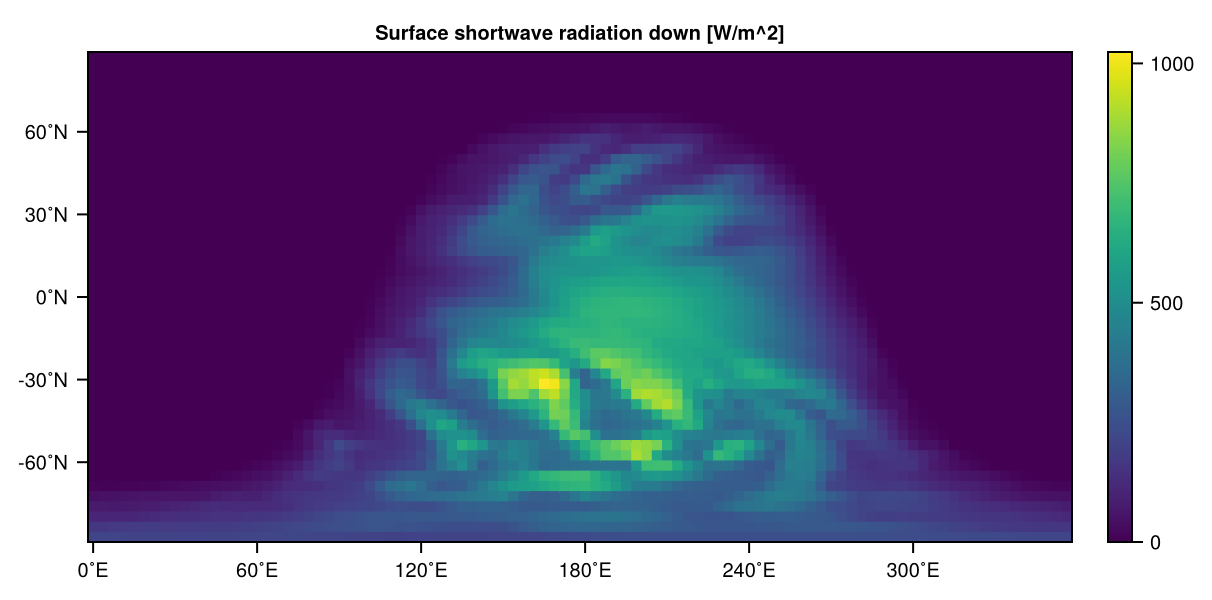
osr = simulation.variables.parameterizations.outgoing_shortwave
heatmap(osr,title="Outgoing shortwave radiation [W/m^2]")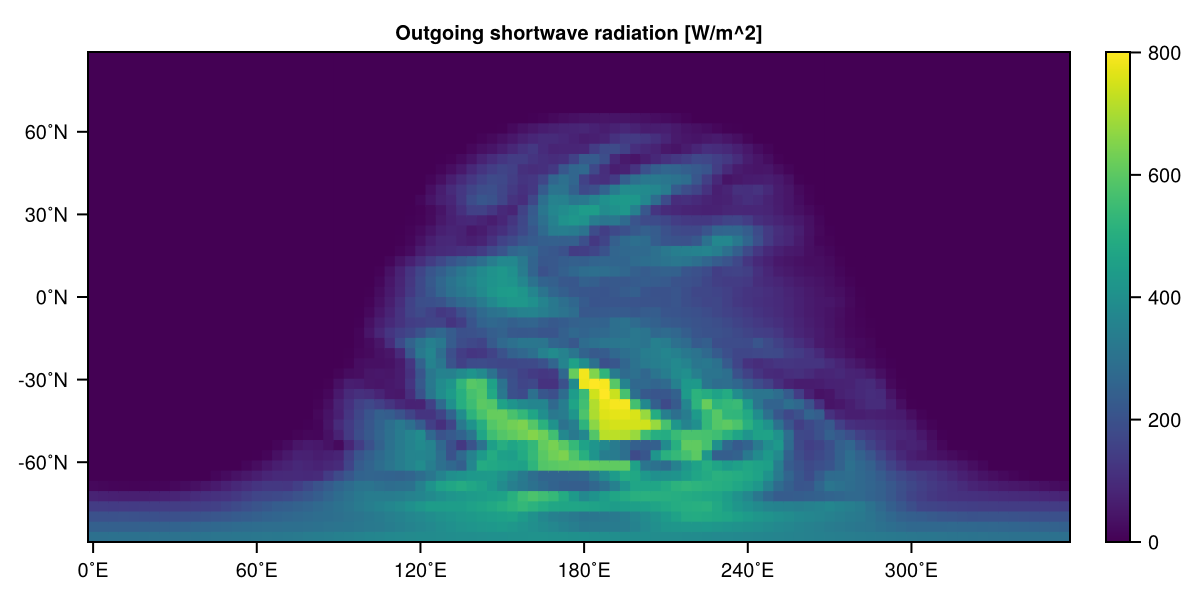
For dry models (no water vapor or clouds):
Use OneBandGreyShortwave instead, which automatically uses NoClouds and TransparentShortwaveTransmissivity:
using SpeedyWeather, CairoMakie
spectral_grid = SpectralGrid(truncation=32, nlayers=8)
model = PrimitiveDryModel(spectral_grid; radiation=Radiation(spectral_grid; shortwave=OneBandGreyShortwave(spectral_grid), longwave=OneBandGreyLongwave(spectral_grid)))
simulation = initialize!(model)
run!(simulation, period=Week(1))

# The shortwave fluxes can be visualised
ssrd = simulation.variables.parameterizations.surface_shortwave_down
heatmap(ssrd, title="Surface shortwave radiation (dry model) [W/m^2]")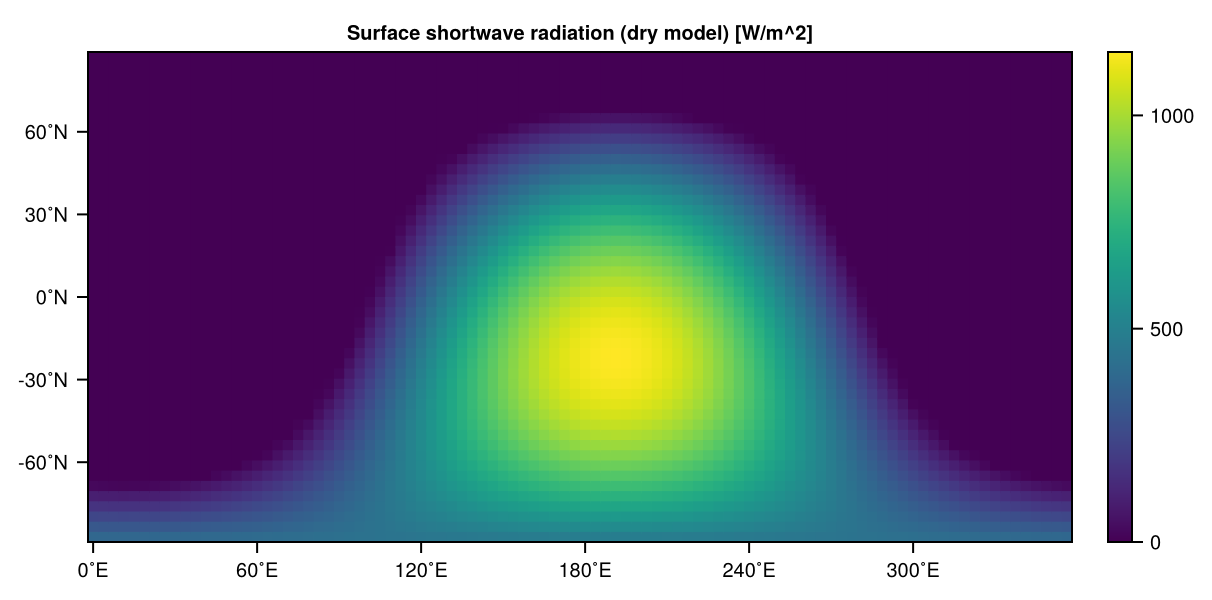
Parameterization options
The OneBandShortwave scheme includes several configurable components:
Cloud schemes
The cloud scheme can be specified when constructing the radiation scheme:
DiagnosticClouds(spectral_grid)(default): Diagnoses clouds from humidity and precipitationNoClouds(spectral_grid): No clouds (used inOneBandGreyShortwave)
Transmissivity schemes
The atmospheric transmissivity can be calculated using:
BackgroundShortwaveTransmissivity(spectral_grid)(default): Fortran SPEEDY-based transmissivity with zenith correction and absorption by aerosols, water vapor, and cloudsTransparentShortwaveTransmissivity(spectral_grid): Transparent atmosphere (used inOneBandGreyShortwave)
BackgroundShortwaveTransmissivity
For each layer
with
is the zenith angle) the column surface pressure dry-air absorptivity ( absorptivity_dry_air)aerosol absorptivity ( absorptivity_aerosol), scaled bywhen aerosols = truewater-vapor absorptivity ( absorptivity_water_vapor) times specific humidity
All absorptivity coefficients are per OneBandShortwaveRadiativeTransfer.
TransparentShortwaveTransmissivity details
Sets
Stratocumulus clouds
The DiagnosticClouds scheme includes a use_stratocumulus flag (default: true) that enables the diagnostic stratocumulus cloud parameterization over oceans:
using SpeedyWeather, CairoMakie

spectral_grid = SpectralGrid()
sw_no_sc = OneBandShortwave(spectral_grid, clouds = DiagnosticClouds(spectral_grid; use_stratocumulus=false))

model = PrimitiveWetModel(spectral_grid; radiation=Radiation(spectral_grid; shortwave=sw_no_sc))
sim = initialize!(model)
run!(sim, period=Day(5))
ssrd = sim.variables.parameterizations.surface_shortwave_down
heatmap(ssrd, title="No stratocumulus clouds [W/m^2]")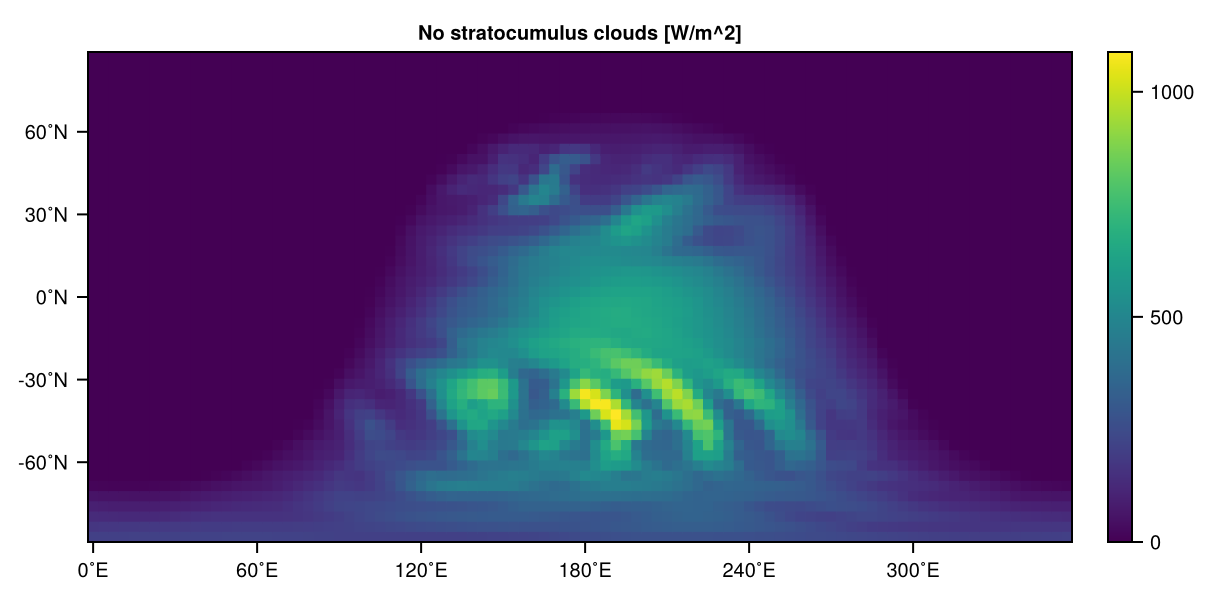
Greenhouse gases
Greenhouse gas concentrations can be prescribed as time-varying scalar quantities and are tracked as prognostic variables. For example, an ExponentialCO2 concentration is fitted to the Keeling curve. To customise or add greenhouse gases, pass a NamedTuple of gas objects to greenhouse_gases. The key of the named tuple will be used for the variable name, so co2 = ..., carbon_dioxide = ... can co-exist.
spectral_grid = SpectralGrid(truncation=32, nlayers=8)

# constant CO2 at 420 ppm
model = PrimitiveWetModel(spectral_grid; greenhouse_gases = (; co2 = CO2(spectral_grid, 420)))
simulation = initialize!(model)
simulation.variables.prognostic.greenhouse_gases.co2[]420.0f0A CO2 concentration that increases exponentially over time:
co2 = ExponentialCO2(spectral_grid)ExponentialCO2{Float32, DateTime} <: SpeedyWeather.AbstractCO2
├ base_concentration::Float32 = 280.0
├ start::DateTime = 1850-01-01T00:00:00
├ a::Float32 = 3.85
└ b::Float32 = 0.020833334Step-change scenarios are also available: TwoTimesCO2 and FourTimesCO2 double or quadruple the preindustrial CO2 at a given date (default: year 2000). Any callable f(t::DateTime) -> concentration_in_ppm can be wrapped in CO2(f) for a fully custom trajectory.
Radiation schemes not yet CO2-aware
The greenhouse gas concentrations are tracked as prognostic variables and evolve correctly in time, but the radiation schemes (OneBandLongwave etc.) have not yet been updated to use them. Changing CO2 therefore has no effect on the radiative fluxes or temperature tendencies at this stage. This is work in progress.