
Grids
The spectral transform (the Spherical Harmonic Transform) in SpeedyWeather.jl supports any ring-based equi-longitude grid. Several grids are already implemented but other can be added. The following pages will describe an overview of these grids and but let's start but how they can be used
using SpeedyWeather
spectral_grid = SpectralGrid(Grid = FullGaussianGrid)SpectralGrid{Spectrum{...}, FullGaussianGrid{...}}
├ Number format: Float32
├ Spectral: T32 LowerTriangularMatrix, 560 harmonics
├ Grid: 48-ring FullGaussianGrid, 4608 grid points
├ Resolution: 2.99°, 333km (at 6371km radius)
├ Vertical: 8-layer atmosphere
└ Architecture: CPU using ArrayThe life of every SpeedyWeather.jl simulation starts with a SpectralGrid object which defines the resolution in spectral and in grid-point space. The generator SpectralGrid() can take as a keyword argument Grid which can be any of the grids described below. The resolution of the grid, however, is not directly chosen, but determined from the spectral resolution truncation and the dealiasing factor. More in SpectralGrid and Matching spectral and grid resolution.
RingGrids is a module too!
While RingGrids is the underlying module that SpeedyWeather.jl uses for data structs on the sphere, the module can also be used independently of SpeedyWeather, for example to interpolate between data on different grids. See RingGrids for how to create grids and fields in practice (this page instead gives the mathematical background of the grids themselves).
Ring-based equi-longitude grids
SpeedyWeather.jl's spectral transform supports all ring-based equi-longitude grids. These grids have their grid points located on rings with constant latitude and on these rings the points are equi-spaced in longitude. There is technically no constrain on the spacing of the latitude rings, but the Legendre transform requires a quadrature to map those to spectral space and back. Common choices for latitudes are the Gaussian latitudes which use the Gaussian quadrature, or equi-angle latitudes (i.e. just regular latitudes but excluding the poles) that use the Clenshaw-Curtis quadrature. The longitudes have to be equi-spaced on every ring, which is necessary for the fast Fourier transform, as one would otherwise need to use a non-uniform Fourier transform. In SpeedyWeather.jl the first grid point on any ring can have a longitudinal offset though, for example by spacing 4 points around the globe at 45˚E, 135˚E, 225˚E, and 315˚E. In this case the offset is 45˚E as the first point is not at 0˚E.
Is the FullClenshawGrid a longitude-latitude grid?
Short answer: Yes. The FullClenshawGrid is a specific longitude-latitude grid with equi-angle spacing. The most common grids for geoscientific data use regular spacings for 0-360˚E in longitude and 90˚N-90˚S. The FullClenshawGrid does that too, but it does not have a point on the North or South pole, and the central latitude ring sits exactly on the Equator. We name it Clenshaw following the Clenshaw-Curtis quadrature that is used in the Legendre transfrom in the same way as Gaussian refers to the Gaussian quadrature.
Implemented grids
All grids in SpeedyWeather.jl are a subtype of AbstractGrid, i.e. <: AbstractGrid (see Grid versus Field for the distinction between a grid and data on a grid). We further distinguish between full, and reduced grids. Full grids have the same number of longitude points on every latitude ring (i.e. points converge towards the poles) and reduced grids reduce the number of points towards the poles to have them more evenly spread out across the globe. More evenly does not necessarily mean that a grid is equal-area, meaning that every grid cell covers exactly the same area (although the shape changes).
Currently the following full grids <: AbstractFullGrid are implemented
FullGaussianGrid, a full grid with Gaussian latitudesFullClenshawGrid, a full grid with equi-angle latitudes
and additionally we have FullHEALPixGrid and FullOctaHEALPixGrid which are the full grid equivalents to the HEALPix grid and the OctaHEALPix grid discussed below. Full grid equivalent means that they have the same latitude rings, but no reduction in the number of points per ring towards the poles and no longitude offset. Other implemented reduced grids are
OctahedralGaussianGrid, a reduced grid with Gaussian latitudes based on an octahedronOctahedralClenshawGrid, similar but based on equi-angle latitudesHEALPixGrid, an equal-area grid based on a dodecahedron with 12 facesOctaHEALPixGrid, an equal-area grid from the class of HEALPix grids but based on an octahedron.
An overview of these grids is visualised here, and a more detailed description follows below.
Visualised are each grid's grid points (white dots) and grid faces (white lines). All grids shown have 16 latitude rings on one hemisphere, Equator included. The total number of grid points is denoted in the top left of every subplot. The sphere is shaded with grey, orange and turquoise regions to denote the hemispheres in a and b, the 8 octahedral faces c, d, f and the 12 dodecahedral faces (or base pixels) in e. Coastlines are added for orientation.
Grid resolution
All grids use the same resolution parameter nlat_half, i.e. the number of rings on one hemisphere, Equator included. The Gaussian grids (full and reduced) do not have a ring on the equator, so their total number of rings nlat is always even and twice nlat_half. Clenshaw-Curtis grids and the HEALPix grids have a ring on the equator such their total number of rings is always odd and one less than the Gaussian grids at the same nlat_half.
HEALPix grids do not use Nside as resolution parameter
The original formulation for HEALPix grids use nlat_half, the number of rings on one hemisphere, Equator included, for all grids. This is done for consistency across grids. We may use
Related: Effective grid resolution and Available horizontal resolutions.
Matching spectral and grid resolution
A given spectral resolution can be matched to a variety of grid resolutions. A cubic grid, for example, combines a spectral truncation nlat_half) such that N=32, i.e. 64 latitude rings in total on an octahedral Gaussian grid. In SpeedyWeather.jl the choice of the order of truncation is controlled with the dealiasing parameter in the SpectralGrid construction.
Let J be the total number of rings. Then we have
dealiasing = 1dealiasing = 2dealiasing = 3
and in general dealiasing is passed onto SpectralGrid on the FullGaussianGrid
| truncation | dealiasing | FullGaussianGrid size |
|---|---|---|
| 32 | 1 | 64x32 |
| 32 | 2 | 96x48 |
| 32 | 3 | 128x64 |
| 43 | 1 | 96x48 |
| 43 | 2 | 128x64 |
| 43 | 3 | 192x96 |
| ... | ... | ... |
You will obtain this information every time you create a SpectralGrid(; Grid, truncation, dealiasing).
Interactively exploring the grids
Based on GeoMakie.jl SpeedyWeather.jl has an extension (meaning only loaded when also using GeoMakie) that defines the globe function which visualises the implemented grids at the desired resolution. With the CairoMakie backend these visualisations are static, but using GLMakie they are interactive. For example
using SpeedyWeather
using GLMakie, GeoMakie

# grid type, resolution parameter nlat_half
globe(FullGaussianGrid, 24)
This will open a window with interactive zoom and rotation, visualising a full Gaussian grid at a resolution of nlat_half = 24 (i.e. 96x48 grid points). You can visualise all grids at a wide range of resolutions for non-interactive plotting use interactive=false, which is also what one should do when using CairoMakie. Additional keyword arguments are coastlines, background among others, check ?globe. You also can visualise data on a grid directly this way which will draw polygons for the cell faces, e.g.
grid = rand(FullGaussianGrid, 24)
globe(grid)
Full Gaussian grid
(called FullGaussianGrid)
using CairoMakie, GeoMakie    # when using GLMakie, use interactive=true (default) for zoom and rotation
globe(FullGaussianGrid, 24, interactive=false)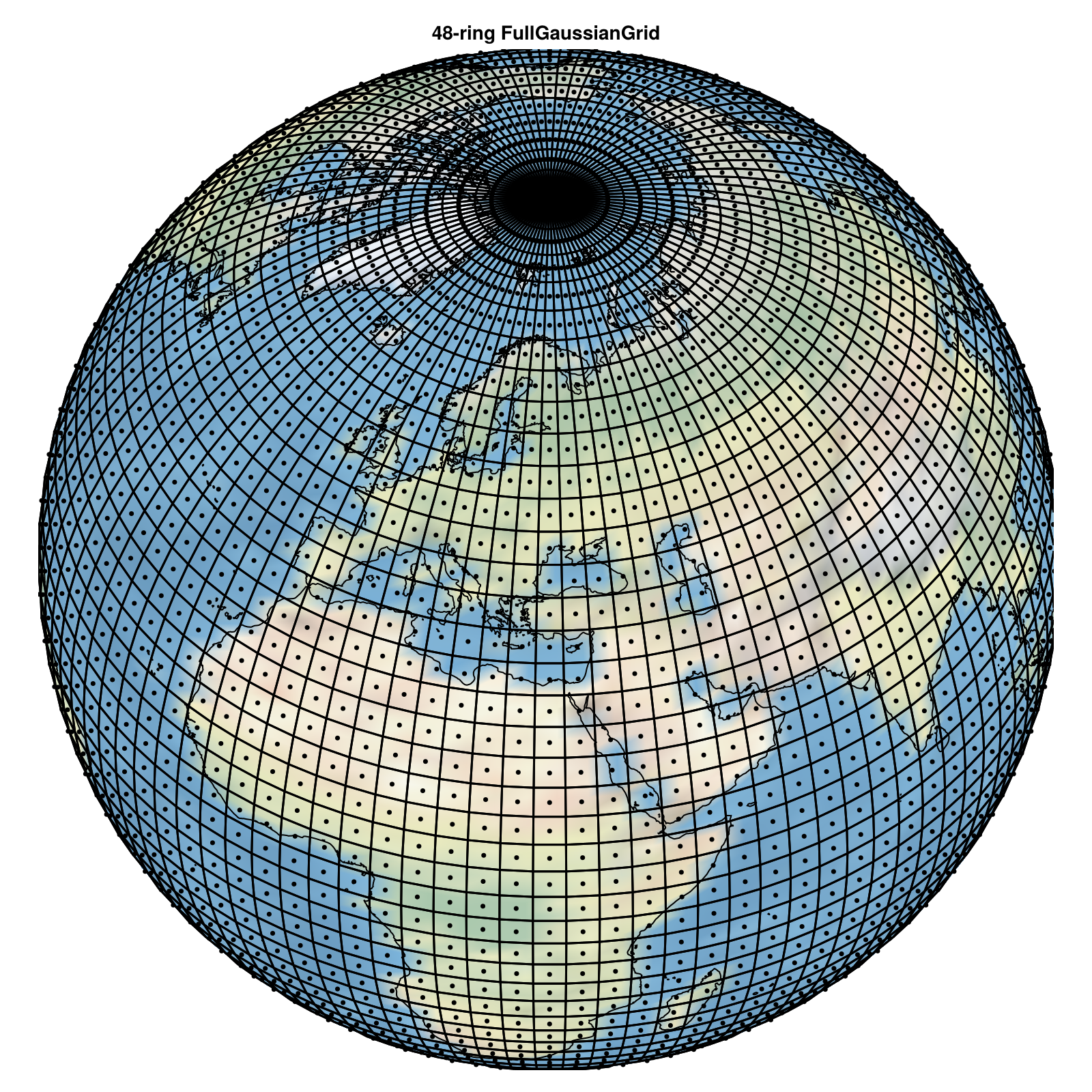
The full Gaussian grid is a grid that uses regularly spaced longitudes with points that do not reduce in number towards the poles. That means for every latitude
with
As it can be easy to mix up latitudes, colatitudes and as the Legendre polynomials are defined in
| Zero crossings | Latitudes [˚N] | |
|---|---|---|
| 2 | ||
| 4 | ||
| 6 |
Only even Legendre polynomials are used, such that there is always an even number of latitudes, with no latitude on the Equator. As you can already see from this short table, the Gaussian latitudes do not nest, i.e. different resolutions through different
On the full Gaussian grid there are in total
Octahedral Gaussian grid
(called OctahedralGaussianGrid)
using CairoMakie, GeoMakie    # when using GLMakie, use interactive=true (default) for zoom and rotation
globe(OctahedralGaussianGrid, 24, interactive=false)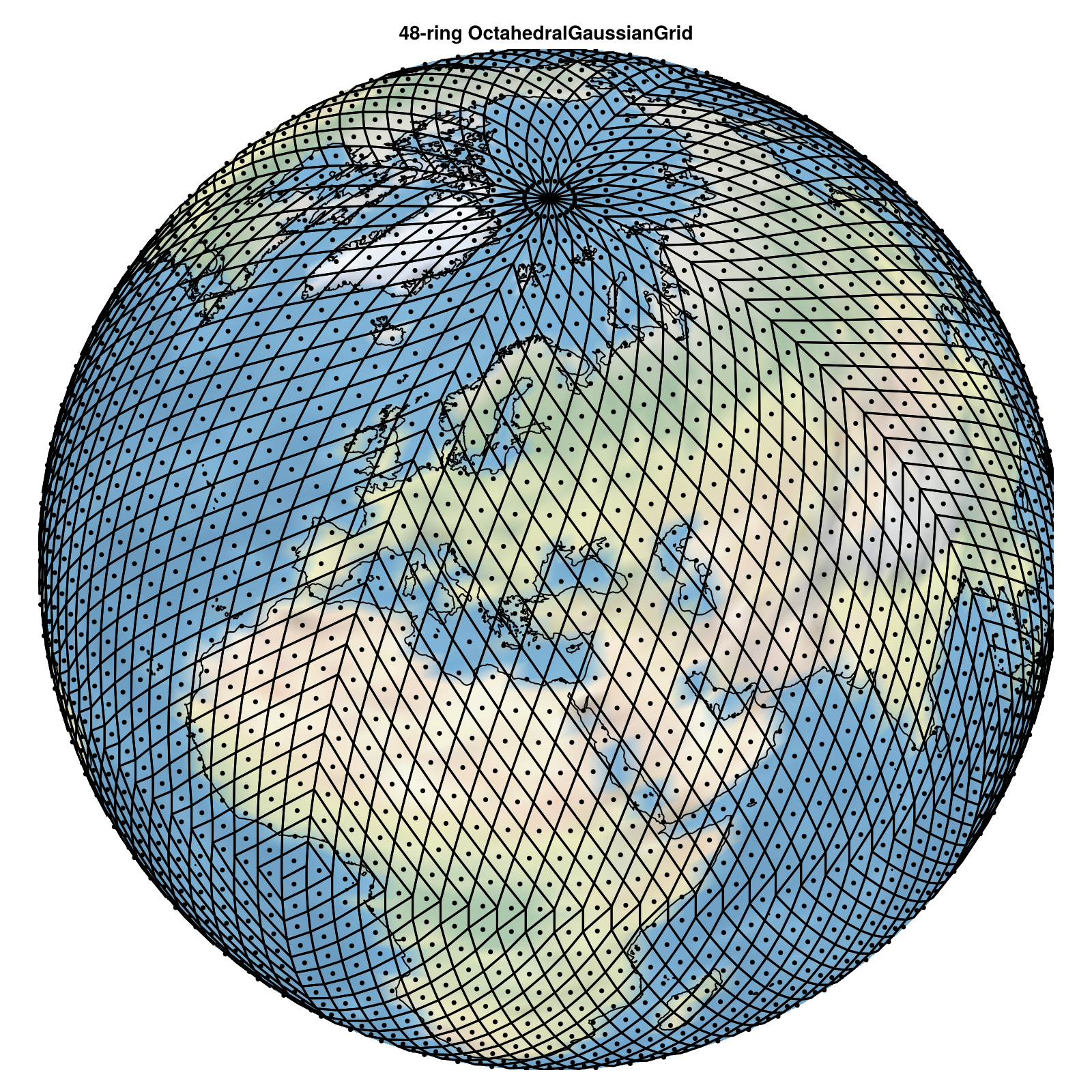
The octahedral Gaussian grid is a reduced grid, i.e. the number of longitudinal points reduces towards the poles. It still uses the Gaussian latitudes from the full Gaussian grid so the exactness property of the spherical harmonic transform also holds for this grid. However, the longitudes
We start with 20 points, evenly spaced, starting at 0˚E, around the first latitude ring below the north pole. The next ring has 24 points, then 28, and so on till reaching the Equator (which is not a ring). For the southern hemisphere all points are mirrored around the Equator. For more details see Malardel et al. (2016).
Note that starting with 20 grid points on the first ring is a choice that ECMWF made with their grid for accuracy reasons. An octahedral Gaussian grid can also be defined starting with fewer grid points on the first ring. However, in SpeedyWeather.jl we follow ECMWF's definition.
The grid cells of an octahedral Gaussian grid are not exactly equal area, but are usually within a factor of two. This largely solves the efficiency problem of having too many grid points near the poles for computational, memory and data storage reasons.
Octaminimal Gaussian grid
(called OctaminimalGaussianGrid)
using CairoMakie, GeoMakie    # when using GLMakie, use interactive=true (default) for zoom and rotation
globe(OctaminimalGaussianGrid, 24, interactive=false)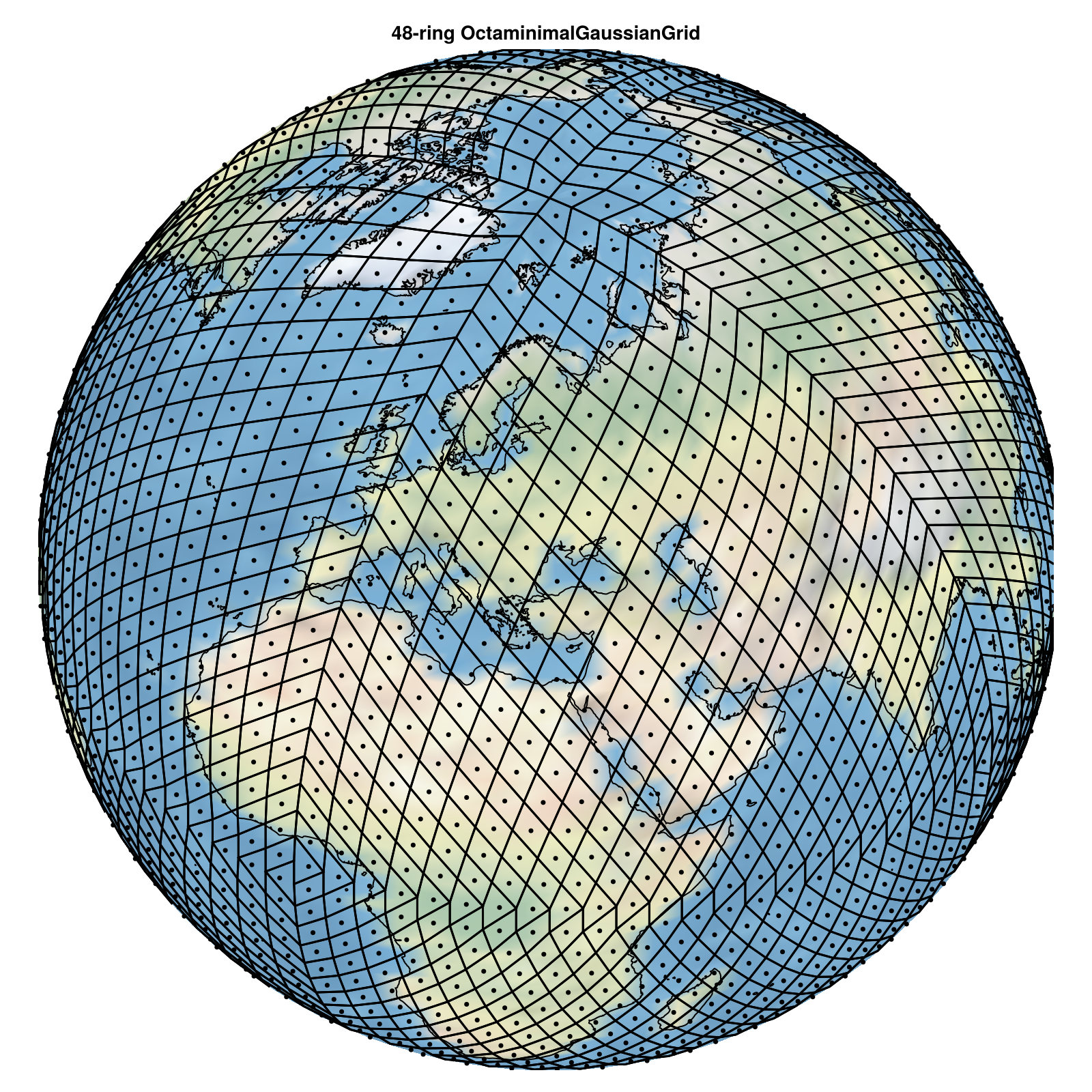
The OctaminimalGaussianGrid is similar to the OctahedralGaussianGrid but starts with 4 points around the poles. It therefore minimizes the number of grid points for the Gaussian grids at the cost of a (somewhat) inexact spectral transform. But for nlat_half = 24 (i.e. 48 latitude rings) this grid reduces the number of horizontal grid points from 3168 to 2400, i.e. -24% which speeds up the computation on the grid (dynamics and physics) as well as the spectral transform. The octaminimal Gaussian grid is intended to be used for low resolutions as for higher resolutions the relative increase in the number of grid points with the octahedral Gaussian grid becomes negligible.
Furthermore the longitudes are rotated: Instead of no offset where the first point on every ring starts at 0˚E, an offset of
Full Clenshaw-Curtis grid
(called FullClenshawGrid)
using CairoMakie, GeoMakie    # when using GLMakie, use interactive=true (default) for zoom and rotation
globe(FullClenshawGrid, 24, interactive=false)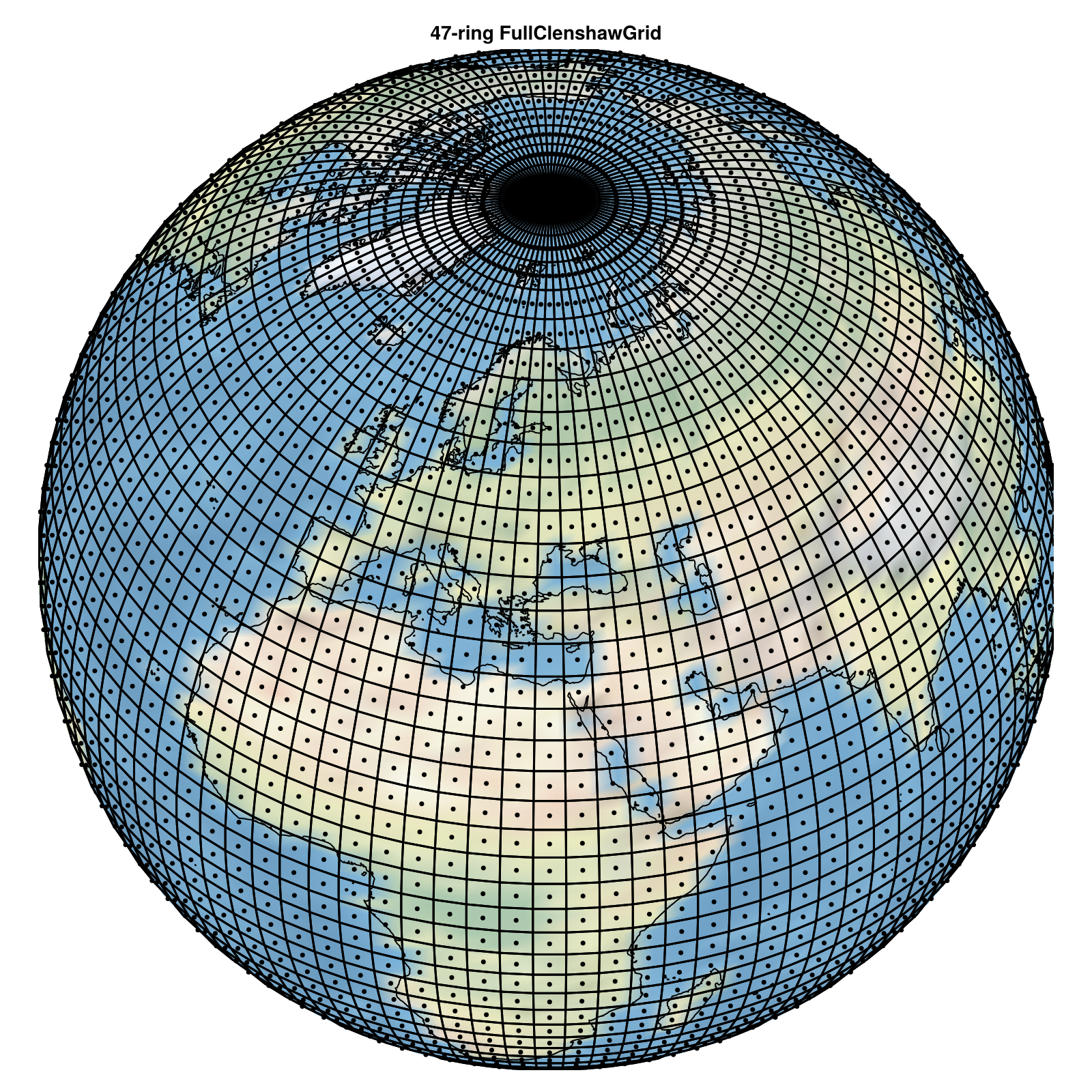
The full Clenshaw-Curtis grid is a regular longitude-latitude grid, but a specific one: The colatitudes
with
The full Clenshaw-Curtis grid gets its name from the Clenshaw-Curtis quadrature that is used in the Legendre transform (see Spherical Harmonic Transform). This quadrature relies on evenly spaced latitudes, which also means that this grid nests, see Hotta and Ujiie (2018). More importantly for our application, the Clenshaw-Curtis grids (including the octahedral described below) allow for an exact transform with cubic truncation (see Matching spectral and grid resolution). Recall that the Gaussian latitudes allow for an exact transform with quadratic truncation, so the Clenshaw-Curtis grids require more grid points for the same spectral resolution to be exact. But compared to other errors during a simulation this error may be masked anyway.
Octahedral Clenshaw-Curtis grid
(called OctahedralClenshawGrid)
using CairoMakie, GeoMakie    # when using GLMakie, use interactive=true (default) for zoom and rotation
globe(OctahedralClenshawGrid, 24, interactive=false)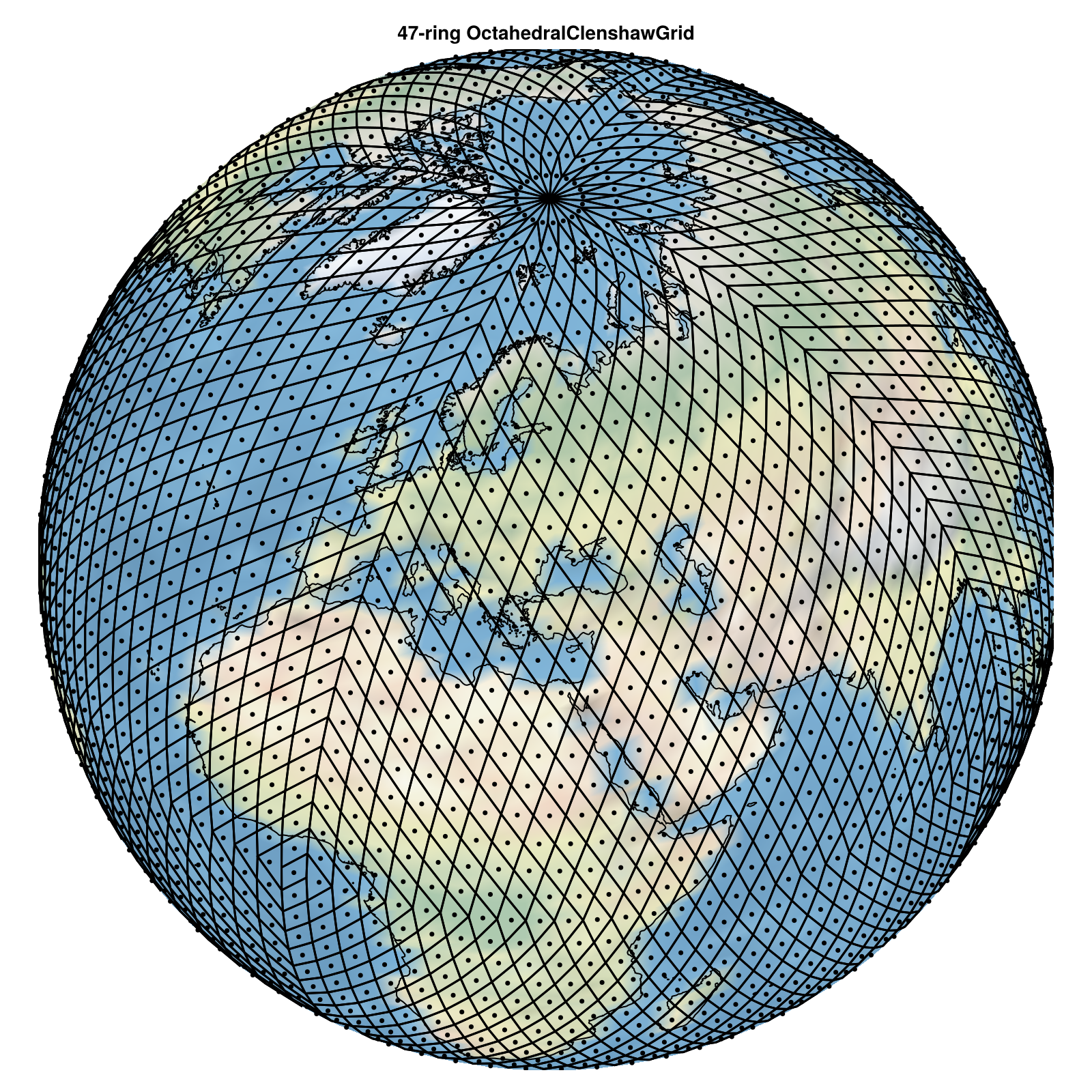
In the same as we constructed the octahedral Gaussian grid from the full Gaussian grid, the octahedral Clenshaw-Curtis grid can be constructed from the full Clenshaw-Curtis grid. It therefore shares the latitudes with the full grid, but the longitudes with the octahedral Gaussian grid.
Notation as before, but note that the definition for
HEALPix grid
(called HEALPixGrid)
using CairoMakie, GeoMakie    # when using GLMakie, use interactive=true (default) for zoom and rotation
globe(HEALPixGrid, 24, interactive=false)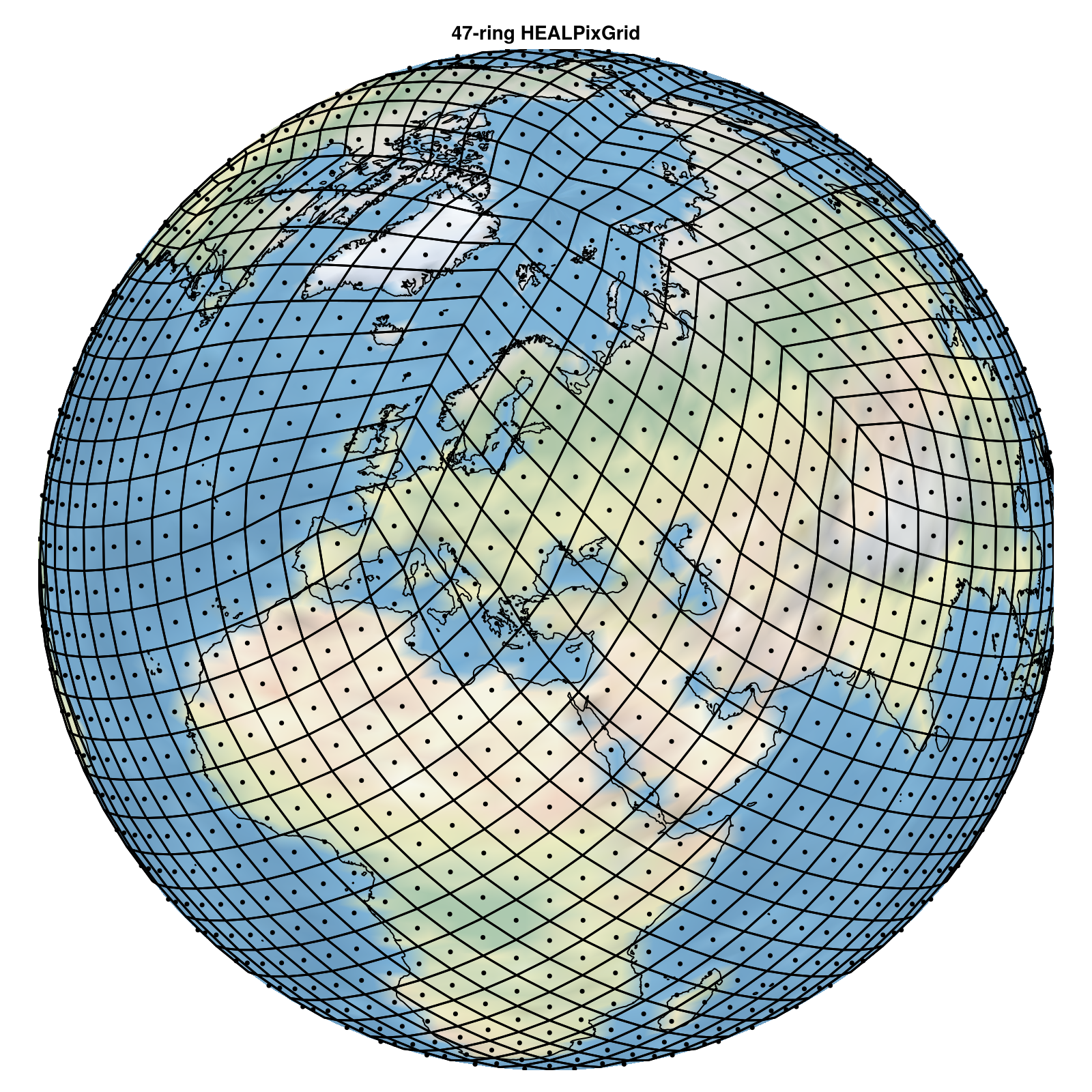
Technically, HEALPix grids are a class of grids that tessalate the sphere into faces that are often called basepixels. For each member of this class there are
Following Górski et al. (2005), the
and on that ring, the longitude
The in-ring index
In the north equatorial belt
and the longitudes change to (
The modulo function comes in as there is an alternating longitudinal offset from the prime meridian (see Implemented grids). For the southern hemisphere the grid point locations can be obtained by mirror symmetry.
Grid cell boundaries
The cell boundaries are obtained by setting
with
OctaHEALPix grid
(called OctaHEALPixGrid)
using CairoMakie, GeoMakie    # when using GLMakie, use interactive=true (default) for zoom and rotation
globe(OctaHEALPixGrid, 24, interactive=false)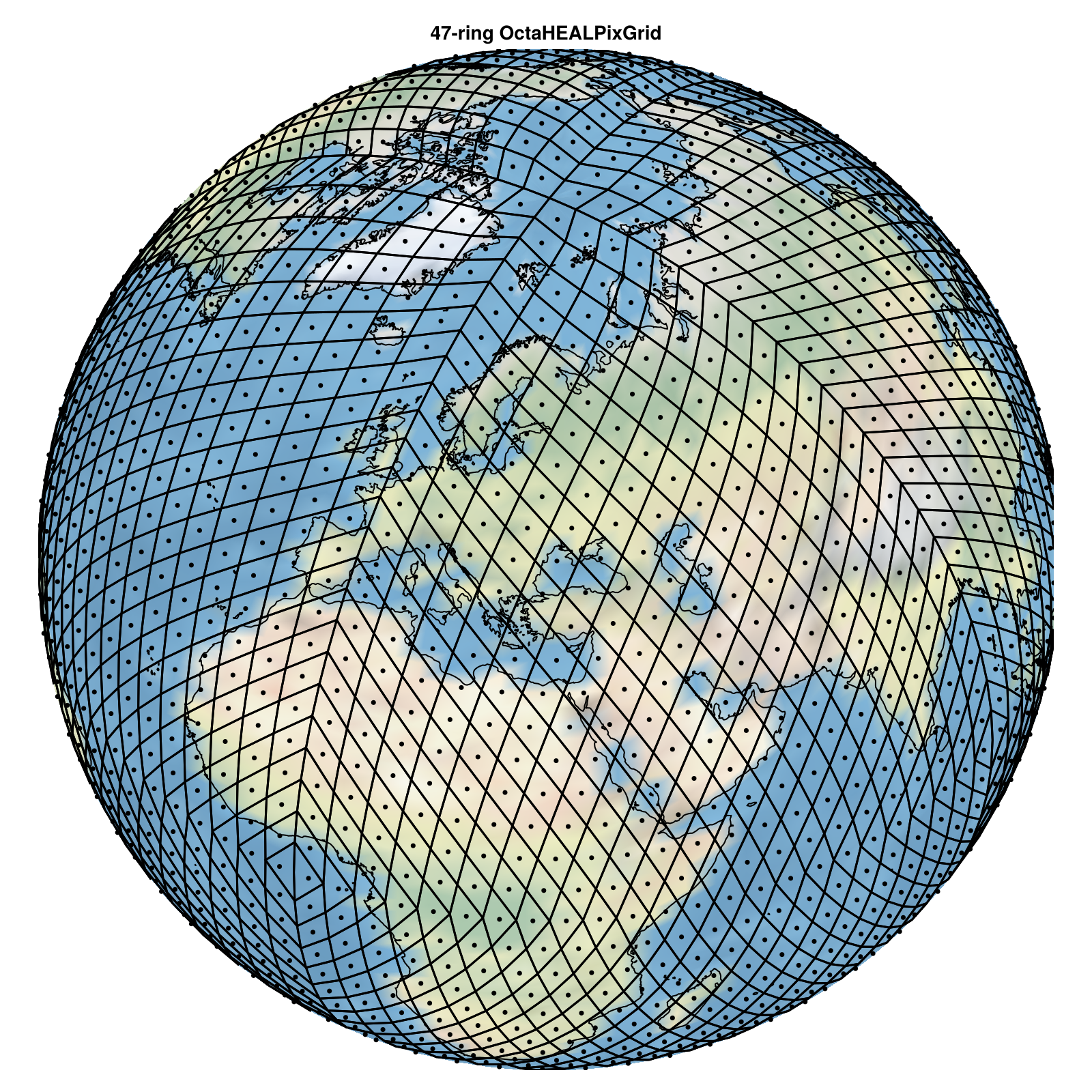
While the classic HEALPix grid is based on a dodecahedron, other choices for
We call the OctahedralGaussianGrid or the OctahedralClenshawGrid. As OctaHEALPixGrid is defined by
with nlat_half, the number of latitude rings on one hemisphere, Equator included, because each of the 4 basepixels spans from pole to pole and covers a quarter of the sphere. The longitudes with in-ring- index
and again, the southern hemisphere grid points are obtained by symmetry.
Grid cell boundaries
Similar to the grid cell boundaries for the HEALPix grid, the OctaHEALPix grid's boundaries are
The